Hong Kong's Quiet Advantage in the Next Downturn
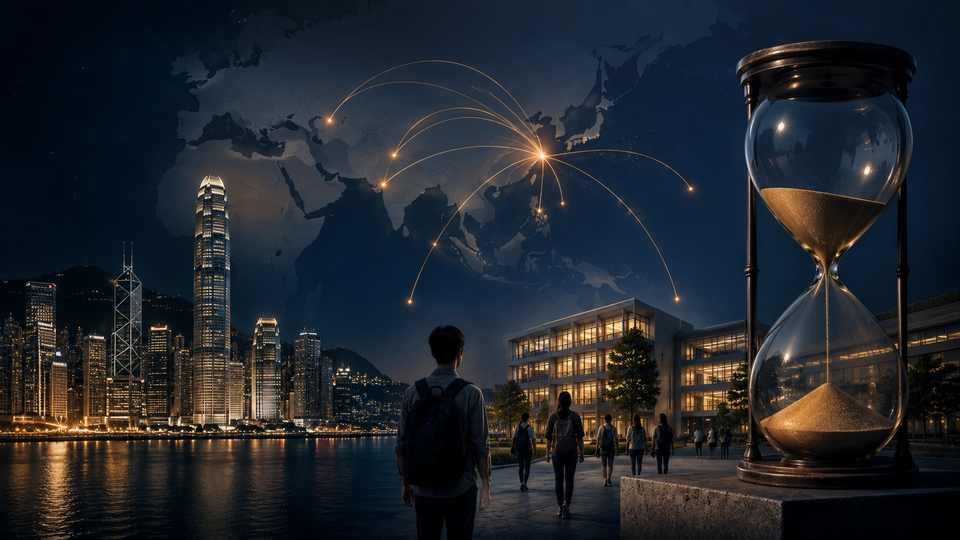
In How Countries Go Broke, Ray Dalio makes a point that is easy to forget when markets are calm: the cycle always turns. Economies rise and fall in long, repeating waves. Dalio's short-term debt cycle has averaged about six years, give or take three, driven by the rhythm of central banks loosening and tightening credit. The last clear trough was 2020, when COVID brought the world to a halt. By that arithmetic, the next turning point may not be far away.
Most people read this as a reason for fear. The more useful question is different. When the cycle turns, what structural advantage can a city lean on? For Hong Kong, the answer may be sitting in plain sight.
The Asset Hong Kong Undervalues
Hong Kong is home to an extraordinary concentration of world-class universities. Five of them rank within the global top 100 according to the QS World University Rankings, clustered inside a single city. Very few countries can claim that density. Almost none can claim it within one urban area.
This is one of Hong Kong's most underappreciated forms of soft power. While the conversation about the city's future tends to fixate on finance and property, its universities represent something more durable: a magnet for talent that does not depend on interest rates, market sentiment, or the next policy cycle.
The Problem With Relying on One Source
The vulnerability is concentration. Roughly seventy percent of non-local students currently come from the mainland. That is a strength today, but a single-source dependency is rarely a foundation for long-term stability.
The opportunity lies in broadening that base, and Southeast Asia is the obvious frontier. The region has grown impressively in recent years. A rising middle class in markets like Thailand, Indonesia, and Vietnam is producing more families able to send their children abroad for education. Hong Kong is closer, more connected, and arguably more globally networked than many of the destinations these students currently consider.
This is also how Hong Kong earns its title. The city calls itself Asia's World City. Becoming the destination of choice for the next generation of Southeast Asian students is exactly how that slogan becomes a reality rather than a tagline.
A Personal Lens on the Opportunity
This is not an abstract thesis for me. My mother is Thai. Forty years ago, her generation already saw Hong Kong as a city of extraordinary wealth and opportunity, a place worth travelling to in search of a better future. What has changed since then is purchasing power. Southeast Asian families who once admired Hong Kong from a distance are now, in growing numbers, wealthy enough to send their children here.
The travel data already shows the shift. Hong Kong's tourism grew nearly 12% in 2025, and for the first time the rebound was driven not only by the mainland but by Thailand, the Philippines, Vietnam, and other Southeast Asian markets, several of which have matched or exceeded pre-pandemic arrival levels. Visitors from this region now spend an average of HK$7,100 per trip. Tourism is often the leading indicator of deeper ties. Where travellers go first, students and capital tend to follow.
Attracting Talent, Not Just Enrolments
Recruiting students is only the first step. The deeper prize is retention. A student who studies in Hong Kong, finds support to settle, and builds a career here becomes something far more valuable than a tuition payment. They become talent, a bridge between Southeast Asia's growth and Hong Kong's economy.
That requires infrastructure, both physical and institutional: accommodation, pathways to employment, and a genuine sense that this is a city where an outsider can put down roots. The cities that win the competition for global students are the ones that make staying as easy as arriving.
Where Property Comes In
This is where the Northern Metropolis matters. A planned university town in the New Territories could anchor a long-term, structural source of housing demand that has nothing to do with speculation. Student populations are stable. They renew every year. They do not panic-sell in a downturn or chase prices in a boom.
A property market underpinned by education and talent is a healthier market than one driven by leverage and sentiment. It is demand built on people who are here to learn, work, and stay.
Planting in the Downturn
Cycles turn. That much is certain. But the cities that emerge strongest are the ones that use the quiet years to plant rather than panic.
Hong Kong already holds a rare hand: five top-100 universities most nations would envy. The task now is to play it, to open the doors wider, welcome the next generation of students from beyond the mainland, and build the foundation for a property market and an economy that can stand on talent rather than timing.
The next downturn is coming. The question is what we choose to build before it arrives.