The Peg's Hidden Price
Last week, I wrote about the Japan lesson: countries with printing presses do not default. They debase. Wages stagnate, the currency quietly loses half its purchasing power, and the government's balance sheet survives while the household's savings pay for it.
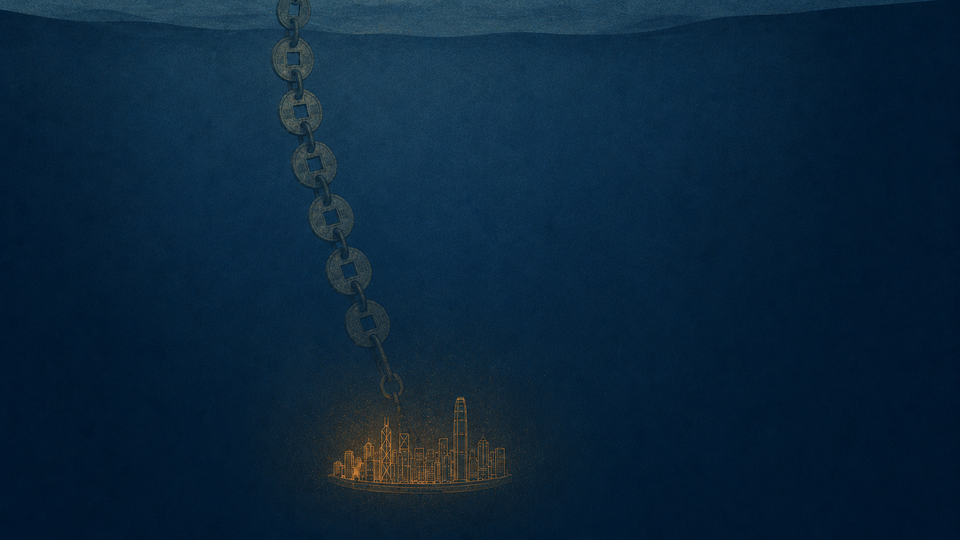
I ended with a question. If the United States is deep in the late stage of its own debt cycle, and the resolution comes the quiet way, through printing and suppressed real rates, what happens to a city whose currency is chained to the dollar?
That city is ours. And the answer deserves to be spelled out.
The Deal Hong Kong Signed
The peg has served Hong Kong well for over four decades. It delivered stability, credibility, and a currency the world trusts. Nobody sensible proposes abandoning it.
But every deal has a price, and the peg's price is this: Hong Kong imports American monetary policy without American benefits.
When Washington prints, the new dollars flow first through American banks, American asset markets, American fiscal programmes. The United States collects what economists call seigniorage, the profit of issuing the world's money. It spends stimulus on its own citizens. Its debts shrink in real terms because they are denominated in the very currency being debased.
Hong Kong gets none of that. No printing press, no stimulus cheques, no debt relief. What we get is the debasement itself: a currency losing real purchasing power in lockstep with the dollar, applied to a population that never voted for it and an economy running on a completely different cycle.
We bear the cost of America's debt cycle. We do not share its rewards.
What This Does to Property
Here is where it gets uncomfortable for the asset every Hong Kong family watches most closely.
The instinct is to assume that money printing lifts property. That was the story from 2009 to 2019, when near-zero rates and QE tripled real residential prices. But that era had a second ingredient people forget: supply was falling. Cheap money met scarce flats, and prices exploded.
The next easing cycle will meet the opposite. Roughly 100,000 units sit in the pipeline. Commercial and industrial property has already lost its investment case. Residential demand is real but structural, not speculative.
So consider the quiet scenario. The Fed eventually returns to expansionary policy. Money supply swells. Nominal Hong Kong property prices may hold, may even rise modestly. But measured against the flood of new money, against gold, against the assets that cannot be printed, property in a supply-heavy market can lose real value for years while appearing stable on paper.
That is the Japanese homeowner's experience, translated into Cantonese. The number on the valuation stayed similar. What the number could buy did not.
What Holds Its Ground
If the endgame of every big debt cycle is debasement, the logical question is what cannot be debased.
History's answer is assets with fixed or disciplined supply. Gold has played that role for five thousand years, and central banks, the very institutions doing the printing, have been buying it at record pace. And for those who accept the logic of gold, it is worth understanding the newer entrant built on the same principle: Bitcoin's supply is capped by code rather than geology, which is precisely why the debasement argument, if you believe it, applies to it with even more force.
To be clear, none of this is investment advice, and both assets carry real volatility and risk. The point is narrower: in a world where the money itself is the thing being spent down, the scarce and unprintable deserve a place in one's thinking.
The Bottom Line
The peg is not a mistake. It is a trade: stability today, in exchange for importing whatever the dollar becomes.
For forty years that trade was clearly worth it. It probably still is. But as the American debt cycle enters its late stage, the invisible side of the bill is coming due, and the people who understand what they are actually holding, and what quietly loses ground in a debasement, will navigate the next decade far better than those who only watch the nominal numbers.
The lesson of Japan was that a country can go broke without defaulting. The lesson for Hong Kong is that a city can pay for someone else's debt cycle without ever borrowing.