PBSA: The Missing Part of the Conversation
Everyone says the student accommodation market in Hong Kong is overheating. They are looking at the wrong numbers.
The conversation around student accommodation has largely focused on conversions, office buildings, hotels and older assets being repurposed into student housing. Very little attention has been placed on true Purpose-Built Student Accommodation (PBSA) and the structural supply gap underneath it.
The reality is that PBSA demand is not a passing trend. It is the result of a shortage that has been building for years and one that remains far from resolved.
The Numbers That Matter
University-managed beds across all 13 major Hong Kong institutions total approximately 45,179. Against a non-local student population already exceeding 80,000 and growing, the gap is not a market inefficiency. It is a structural deficit.
The private market has grown in recent years, but remains a fraction of what is needed. According to CBRE, by 2028 the total bed shortfall will exceed 63,000, the highest on record. When supply is this far behind demand, calling a market "too hot" misses the point entirely.
How Students Currently Find Housing
The existing supply of private student accommodation falls into four broad categories, each with significant limitations.
The first is residential subletting and subdivided flats. For years, softening residential prices made it economically rational for owners to convert units into student accommodation rather than sell into a weak market. That calculus is changing. As residential prices recover, developers are pulling back. Henderson Land recently confirmed it would reclaim its Tai Po development "Parkwood," which had been leased to CUHK as off-campus student housing, with plans to either sell or re-let the units commercially. It is not an isolated case. As the residential market firms up, this supply channel will continue to shrink.
The second is old residential buildings, known locally as tong lau. Many remain affordable and accessible, but they are ageing, typically without lifts, and require significant capital expenditure to maintain. The Basic Housing Units Ordinance will further increase conversion costs for owners, making this segment progressively less viable over time.
The third is hotel conversions. With inbound tourism to Hong Kong remaining subdued, some hotel owners have pivoted to student accommodation or sold to operators who have. For lower-tier hotel owners in particular, student accommodation offers a viable exit strategy, a way to reposition a struggling asset without a full redevelopment. The fundamental limitation is efficiency. Hotels are designed around common areas, lobbies, corridors, amenity spaces — that generate no rental income. Operators compensate by converting these spaces into study rooms, but low utilisation drags down the overall value per square foot. Hotel conversions work. They simply do not work as well as purpose-built alternatives.
The fourth is commercial building conversion, a route the government introduced last year to unlock underutilised office stock for alternative uses. In practice, the regulatory requirements have proven restrictive. Most modern commercial buildings, with sealed facades and centralised ventilation systems, cannot meet the natural ventilation standards required for residential or student use. The more viable candidates are older commercial buildings with operable windows, which offer the airflow flexibility that regulators demand. The pipeline here is real but narrow, constrained by both physical building characteristics and the complexity of the approval process.
Why PBSA Changes the Equation
Purpose-built student accommodation is the newest entrant to this market, and structurally the most compelling. In established university cities across Australia, Canada, and the United Kingdom, PBSA has become a recognised and mature asset class. Institutional investors, dedicated operators, and purpose-built supply pipelines are commonplace. Hong Kong, by contrast, has no meaningful track record in this sector. What exists today is largely improvised: residential conversions, hotel repositioning, and informal arrangements that were never designed with students in mind.
Unlike hotels, PBSA is designed from the ground up for student living — maximising usable room area, minimising wasted common space, and delivering a cost per room that is at least 30% lower than hotel conversions, with the gap widening significantly depending on the asset and configuration.
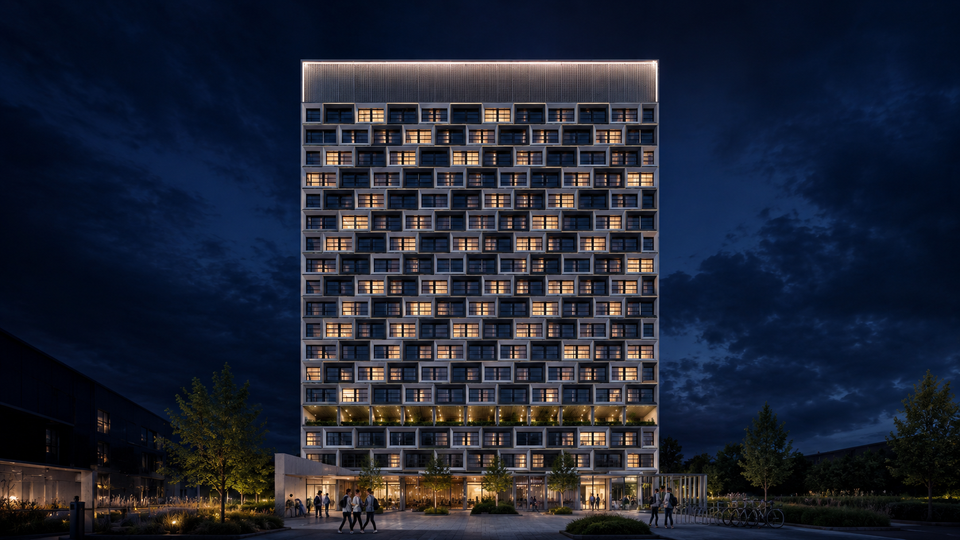
There are currently only two new PBSA projects entering the Hong Kong market. One of them is in Ngau Tau Kok, developed by Star Properties. The efficiency advantage of purpose-built design is not marginal. Hong Kong is, in many ways, starting from zero, which means the opportunity ahead is as large as the track record is short.
A New Road for Hong Kong Property
With the residential market still absorbing significant supply, developers and investors are searching for sectors with cleaner fundamentals. Student accommodation and PBSA in particular, offers exactly that: structural undersupply, a growing non-local student population, a regulatory environment that is eliminating informal alternatives, and a government that has explicitly identified international education as a strategic priority.
The question is not whether Hong Kong needs more PBSA. By every available measure, it clearly does. The question is whether the development pipeline can move fast enough to meet a shortfall that is still widening.
Disclaimer: Jimmy is Managing Director of Sales and Marketing at Star Properties, which is developing one of Hong Kong's first Purpose-Built Student Accommodation projects in Ngau Tau Kok. The views expressed are his own.